Описание
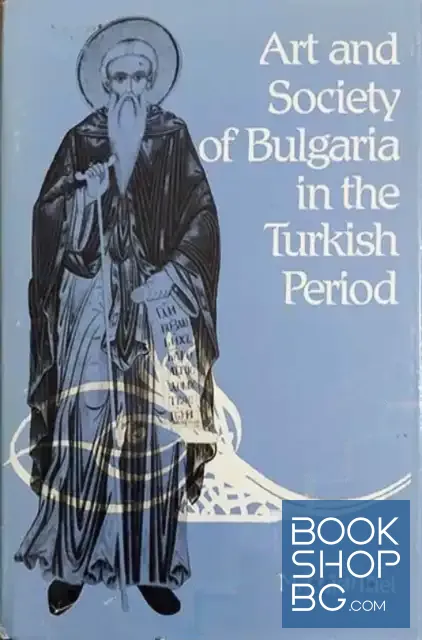
A New Interpretation. Assen (Netherlands), van Gorcum, 9 maps, 7 facsimiles, 77 black-and-white photographs.
Dr. Kiel, a research fellow at the University of Utrecht in the Netherlands, has the advantage of being both an art historian and an expert in the late medieval and modern history of the Balkans. This book is not quite art history, but rather a broad cultural-historical study of a part of south-eastern Europe, which has until now received
limited attention outside Bulgaria itself. However, the writing of art history has been politicized in modern Bulgaria more than in many other European countries.
In his introduction, Kiel presents to the reader this politicized Bulgarian view of their country’s history and art, as follows:
"In the decade prior to the Ottoman conquest, the economic and cultural life of the country, architecture, painting, and literatüre, reached a high level of development. A guiding role in this development was played by the Capital city of the country at that time, Tarnovo, producing the so-called " School of Tarnovo" in architecture and painting. The Ottoman conquest, which followed this period of cultural expansion, was particularly violent. It disrupted Bulgarian society and culture brutally and threw back the country for centuries (we will call it the "Catastrophe Theory"). The regime set up by the conqueror had liquidated the chief support of Christian art: court and nobility. The subjugated people were exploited ruthlessly and the Christian religion was discriminated against. It was formally forbidden to erect new churches and very difficult to restore old ones. The disruption of social and cultural development, the large-scale destruction of ancient monuments of Bulgarian art, combined with the economic exploitation and juridical restrictions were responsible for the low level of Bulgarian culture from the 15th to the 17th centuries. Only in the course of the 18th century did the situation begin to change".
In his other chapters, Kiel illustrates various aspects of this "Catastrophe Theory", basing himself on Bulgarian authors, and then re-examines the evidence in the light of additional materials - reaching very different conclusions. The author has used source
materials in the Ottoman archives in İstanbul and Ankara as well as the literatüre in the local Balkan languages. Moreover, he has traveled extensively, visiting many little-known monuments in Bulgaria and adjoining countries - in order to get an overview of art creativity in the Balkan countries under Ottoman rule. Kiel’s central thesis is that the Ottoman conquest and the subsequent regime were not primarily responsible for the low level of Bulgarian art and culture in the first centuries of the Ottoman period. Of prime
importance is the low level of Bulgarian art prior to the Turkish conquest, the political disunity and civil wars and the utter impoverishment and depopulation of large areas before 1370. The low level of Bulgarian art can only be seen when comparing it with what
was produced in the lands just outside Bulgaria. In Bulgarian writing on art, this comparison is hardly ever attempted. In order to reach his conclusion, the author first attacks the current view about the brutal and violent Ottoman conquest, held responsible for the sudden destruction and disappearance of the old Bulgarian culture. Kiel’s argument is that the disappearance of the old Bulgarian culture and its monuments was a process stretching out over many centuries. It had even not come to an end in 1960.
In the years after World War II some of the oldest still existing Bulgarian churches (ıoth century) were destroyed by ignorants and beautiful wall paintings were destroyed by modern visitors. Most of the old Bulgarian towns were destroyed not by the Ottomans in 1393 (the end of the Bulgarian State) but by the crusading armies of western Europe during the Crusade of Varna in 1444. About the conquest of Bulgaria by the Ottomans there is no local source of eyewitnesses, only a hagiography, written long after the events by someone who was not interested in history but to glorify a saint.
Yet this source, which became available to the historian more than a hundred years ago, was taken literally. The source that does contain eyewitness accounts however is the compilation of Mevlana Neşri. It became available for the Bulgarians only in recent decades, through the Yugoslav translation of Glişa Elezovic. Neşri’s account makes it clear that the towns of Bulgaria were not destroyed during the conquest but surrendered without a fight. Archeological research on a truly impressive scale, carried out in Bulgaria in the last thirty years, confirms Neşri’s account. His version of the events was accepted by some of the most independent Bulgarian historians and by leading archeologists responsible for the above excavations. Lastly, all medieval Bulgarian castles but one (Vidin) were blown up by the Russian army under Kutuzov, when it retreated from invaded Bulgaria in 1810/11. What remained of old Bulgarian churches and monasteries was finished off during the decades of anarchy by mutinous bands of soldiers after the above-mentioned war, when the Ottoman Government had entirely lost control of the affairs in the province. What was left of the medieval monuments and many of those from the early Ottoman period disappeared in the years 1830-1870, when Bulgaria went through a spectacular phase of
economic, cultural, and national revival and reconstruction, the so-called "Bulgarian Renaissance". In that time, countless new churches were built and painted and the old ones were simply demolished, not being monumental enough for the changed taste. In the best case, they were left as abandoned ruins, cared for only by the restorers of the last twenty years of our time.
Briefly, there was no catastrophic and sudden break between the old medieval Bulgarian culture and that of the Ottoman period, but a gradual disappearance of it. The case of the destruction of the old capital of Tarnovo, as related in the old Bulgarian hagiography,
stands out isolated, as an exception confirming the general rule.
In a special chapter, the author describes the structure of Bulgarian society in the Ottoman period, pointing to groups in that society able to promote Christian culture. For this, he uses Ottoman documents combined with buildings actually built by those different groups of society, always comparing them with works outside Bulgaria. Then Kiel attempts to demonstrate that the picture the Ottoman documents give about rebuilding churches or building totally new ones, differs greatly from the actual situation in the countryside.
In the I5th and ı6th centuries, numerous towns and villages were founded by the Ottomans. They had a mixed Muslim-Christian population and were built on sites where there had never been a settlement before. Yet in all those places we see old churches, standing side by side with the mosques. Sarajevo, the Capital of Bosnia, is the best-known case, but there are numbers of others. Much space is also devoted to the financial position of the monasteries and the organization of the church in general. The conclusion is that the possibility of reconstruction or the new building of churches was far greater than
the stern language of the official papers suggests. Legally, Christianity could exist freely and function under its bishops, patriarchs and abbots. When it could be proved that a settlement had had a church before the Ottoman conquest, nothing could prevent the
local Christians from rebuilding that church. They found the Holy Law of İslam on their side. Nevv building was indeed legally forbidden but was tolerated widely at the local level, when the contacts between the local Muslims and Christians were in harmony. The author points to districts where the Ottomans depended heavily on the loyalty of their local Christian militia. In such areas, the possibility of building entirely new and monumental churches and monasteries was the largest. In the daily practice of running a multi-national empire, the possibilities for the expansion of Christian art was far
greater than it seemed on paper.
If Bulgarian culture and art did not disappear with one resounding bang because of the supposed violent Ottoman conquest, if there was indeed a material foundation on which this art could flourish after the court and nobility had vanished, and if there was indeed a possibility to build new churches, what is than the real reason why Bulgarian art lagged so visibly behind that in Albania, Greece or Serbia and Macedonia? The author tries to find the answer to the relatively low development of Bulgarian art in the 14th century,
that is, in the century preceding the Ottoman conquest. There was simply much less to pass on to the next generations. In order to show this, the author - after having first stated the current Bulgarian view - surveys the art of the Second Bulgarian Empire (i3th-i4th
century) and attacks especially the supposed existence of a magnificent "School of Tarnovo" in architecture and painting. To bring the supposed magnificence of the art of that period back to more realistic proportions, he compares it with the productions of the same groups of society in the neighbouring countries, as well as with the products of Early-Ottoman architecture. The latter comparison is particularly enlightening because it shows that the by far largest building of the Second Empire, the palace of the Tsars in Tarnovo, easily fits into a Seljuk or Ottoman khan, not built for a ruler and his family but for the common man. A handful of churches or bishops’ cathedrals of medieval Bulgaria would easily fit into an Ottoman hammam of the early I5th century and the best of the churches of the most powerful nobleman of the i3th century is so small that it fits in one’s dining-room! This comparison, although not acceptable for everyone, is of interest, because in Balkan historiography it is a favourite topic to maintain that the Ottoman conquerors came into the Balkans without any culture of their own at all.
In summary: This is an expert study on an important subject, opening new vistas through its bold use of new and old materials and by their analysis, leading to new interpretations. The numerous photographs of art monuments and book illuminations will also be appreciated by the reader.
Jacob M. Landau